With more than 50 years of experience, Amm GmbH & Co. KG Spedition is one of the established logistics service providers in the Nuremberg metropolitan region. As a CargoLine partner, the family-owned company offers national and international transport solutions as well as services in the fields of container, contract and heavy-duty logistics. Quality, customer proximity and the continuous development of processes and services are at the heart of the company’s operations.
Industry: Freight forwarding, groupage, part & full loads, logistics services
Company Overview: AMM GmbH & Co. KG Spedition
- Headquarters: Nuremberg, Germany
- Founded in 1966; shareholder and partner in the CargoLine network since 1995
- Service portfolio: freight forwarding, contract logistics, warehousing, and national and international transport
- Logistics facilities: several warehouse and transshipment sites in the greater Nuremberg area
From groupage pressure to process excellence
AMM GmbH & Co. KG Spedition has been one of the established mid-sized logistics companies in southern Germany for many years. As a partner in the CargoLine groupage network, AMM operates every day within a
highly dynamic network in which reliability, speed and precisely coordinated processes are decisive.
Requirements in the groupage business keep rising: higher shipment volumes, tighter time windows, a shortage of skilled staff and increasing cost pressure. Against this background, AMM decided at an early stage to fundamentally rethink its own short-haul dispatch – with one clear goal: more automation, more transparency and fewer operational dependencies.
Today the company plans around 95 percent of its short-haul dispatch automatically – and in doing so has not only changed dispatch itself, but has also sustainably changed and optimized the workflows in the transshipment terminal.
From dependence on individuals to predictable dispatch
Before the software was introduced, dispatch was strongly tied to manual processes. Planning mainly took place at night and permanently occupied two to three full-time employees. At the same time, it became increasingly difficult to recruit qualified staff for night work. There was another risk on top of this: the operational know-how lay with a few experienced employees. If they were absent, a bottleneck quickly arose in day-to-day business.
AMM wanted to reduce these dependencies without jeopardizing the quality of route planning. Today dispatch runs far more structured and predictable. As soon as all relevant data has arrived at around 11 p.m., roughly 96 percent of the shipments are already scheduled.
In the following night run the system independently processes about 1,500 shipments, consolidates stops automatically and creates finished tour manifests for the next morning.From 6 a.m. the loading of the vehicles can start straight away. The classic nightly dispatch work has thus been largely automated.
Flexible planning, not rigid tour logic
A central success factor of the project was the flexible system logic. Instead of prescribing rigid tour models, proLogistik Group’s pLG Tourenplanung software dynamically maps the actual requirements of daily business.
Moritz Reiser, Head of Freight Forwarding at AMM, describes this approach as follows:
“Imagine a big pot into which you throw all shipments. You can then set up the filters in the system so that everything ends up where you need it and how you want it.”
In doing so, the software takes the most varied restrictions and requirements into account – from delivery areas and time windows through to economic parameters such as minimum stops per tour. What AMM finds particularly valuable is that the system continuously evolves and learns from the daily processes. This includes, among other things:
- Automatic suggestions for goods acceptance times
- Dynamic calculation of real dwell times at the customer
- Self-learning address mapping and geocoding
- Continuous optimization of tour quality
As a result, planning becomes more precise and more reliable with every tour driven.
Rethinking processes instead of simply digitizing them
For AMM, the introduction of automated dispatch meant not only new software – but also a rethink of existing workflows. At the beginning, the question was whether all established processes could be mapped digitally at all. It quickly became clear that not every existing workflow had to be adopted one to one.
Moritz Reiser remembers:
“You have to rethink some dispatch processes and sometimes think outside the box. That is how we came across options we had not thought of before.”
AMM deliberately opted for a step-by-step introduction. Smaller delivery areas were piloted first and gradually extended. This reduced risks and allowed the team to gain experience with the new system. Today dispatch works according to the principle of “management by exception”: the employees’ expertise has been stored in the system. The dispatchers concentrate primarily on special cases and deviations reported by the system instead of planning every tour manually. This creates room for strategic tasks while the operational workload is significantly reduced at the same time.
Tangible effects in the transshipment terminal
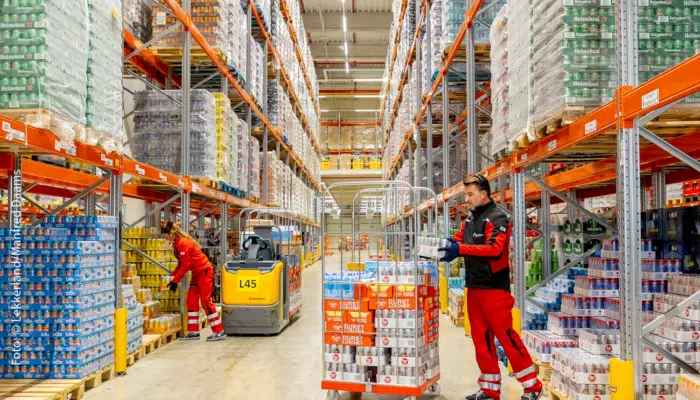
The effects of automated planning are not only noticeable in dispatch itself, they also show directly in the transshipment terminal. In the course of the introduction, the entire tour bay structure was reorganized. Because route planning is now reliable and consistent, only those shipments actually intended for the respective vehicle are staged at the marshalling areas.
The result:
- Less searching
- Hardly any subsequent re-sorting
- Clearer workflows in the terminal
- Faster loading of the vehicles
As a result, loading times per vehicle could be reduced by around 20 minutes on average. At the same time, AMM benefits from considerably more transparency in reporting, which is becoming an ever more important factor, especially in the groupage network.
Acceptance through transparency and ease of use
As with many digitalization projects, there were initial reservations at AMM too – especially among the experienced employees who had worked with established processes for years. The decisive success factor was therefore involving the team. Thanks to the step-by-step introduction, initial successes quickly became visible. At the same time, the software convinced users with its intuitive operation and its clearly structured user interface.
Today the system is fully accepted in everyday work. Its simple handling also ensures that operational capability is maintained even when staff are absent at short notice. In AMM’s assessment, in an emergency even an employee from outside the field could successfully complete a large part of the planning – an enormous advantage in times of a growing shortage of skilled workers.
Conclusion: digitalization as a real competitive advantage
With automated short-haul dispatch, AMM has simplified processes, relieved its employees and noticeably increased efficiency in day-to-day business. The example shows that intelligent dispatch not only creates more transparency and stability, but is increasingly becoming the decisive competitive advantage in the groupage business.
Would you also like to make your dispatch more efficient?
Find out how intelligent route planning and automated dispatch processes can relieve your groupage logistics from dispatch through to the transshipment terminal. Talk to our experts and discover how modern logistics software ensures operational stability, transparency and efficiency.
Practical advice: five rules for a system rollout
Based on his five years of practical experience, Head of Freight Forwarding Moritz Reiser formulates a realistic guide for companies that want to automate their dispatch.
- Master data maintenance: A system is only as good as its data basis. Maintaining it requires care and accuracy.
- Process reflection: Existing workflows should be questioned beforehand and not digitized blindly.
- Provide resources: Implementation requires dedicated staff and time capacity within the company.
- Bring error tolerance: Innovation projects rarely run in a straight line. AMM also had to make adjustments during the process – what is decisive is readjusting together.
- Clear commitment: Management and the project team must fully stand behind the decision and the system.
Thanks to his many years of experience – from his
apprenticeship through dispatch to management positions
he knows the challenges of transport logistics at first hand and
reports on daily practice at Amm in this user story.