
Dangerous Goods

Risk-Minimized Dangerous Goods Transport –
The Key Role of Software and Hardware
Moved by ExpertsA single moment can make all the difference: an incorrectly declared substance, an unnoticed temperature deviation, or an unsuitable route – and a routine transport can turn into a serious risk. Dangerous goods leave no room for error.
Dangerous goods transport is one of the most sensitive areas of logistics. Wherever flammable, explosive, or toxic substances are moved, maximum safety is essential – not only from a regulatory perspective, but also in the interest of people, the environment, and corporate reputation. Qualified personnel and clearly defined processes form the foundation. But only the targeted use of modern software and hardware makes dangerous goods transport safe, transparent, and efficient.
Software Solutions in Dangerous Goods Transport
Digital Intelligence as the FoundationPowerful software is at the heart of modern dangerous goods logistics. Specialized transport management systems (TMS), in particular, play a key role here. They not only map transport orders, but also integrate regulatory requirements into operational processes.
This significantly reduces the risk of human error. At the same time, process speed increases because many manual checks are no longer required.
TMS and Dangerous Goods –
Useful Functions:
- Automatic checking of dangerous goods classifications
- Inclusion of ADR-relevant regulations in planning
- Automated generation of documents and transport papers
- Plausibility checks, such as packaging requirements and quantity limits
Another key component is the Warehouse Management System (WMS). It ensures that dangerous goods are handled correctly while still in the warehouse. The integration of WMS and TMS creates a continuous digital process chain – from inbound delivery to outbound dispatch.
WMS and Dangerous Goods –
Useful Functions:
- Separate storage of incompatible substances
- Automatic control of storage zones according to hazard classes
- Guided processes for putaway, relocation, and picking
Telematics and IoT
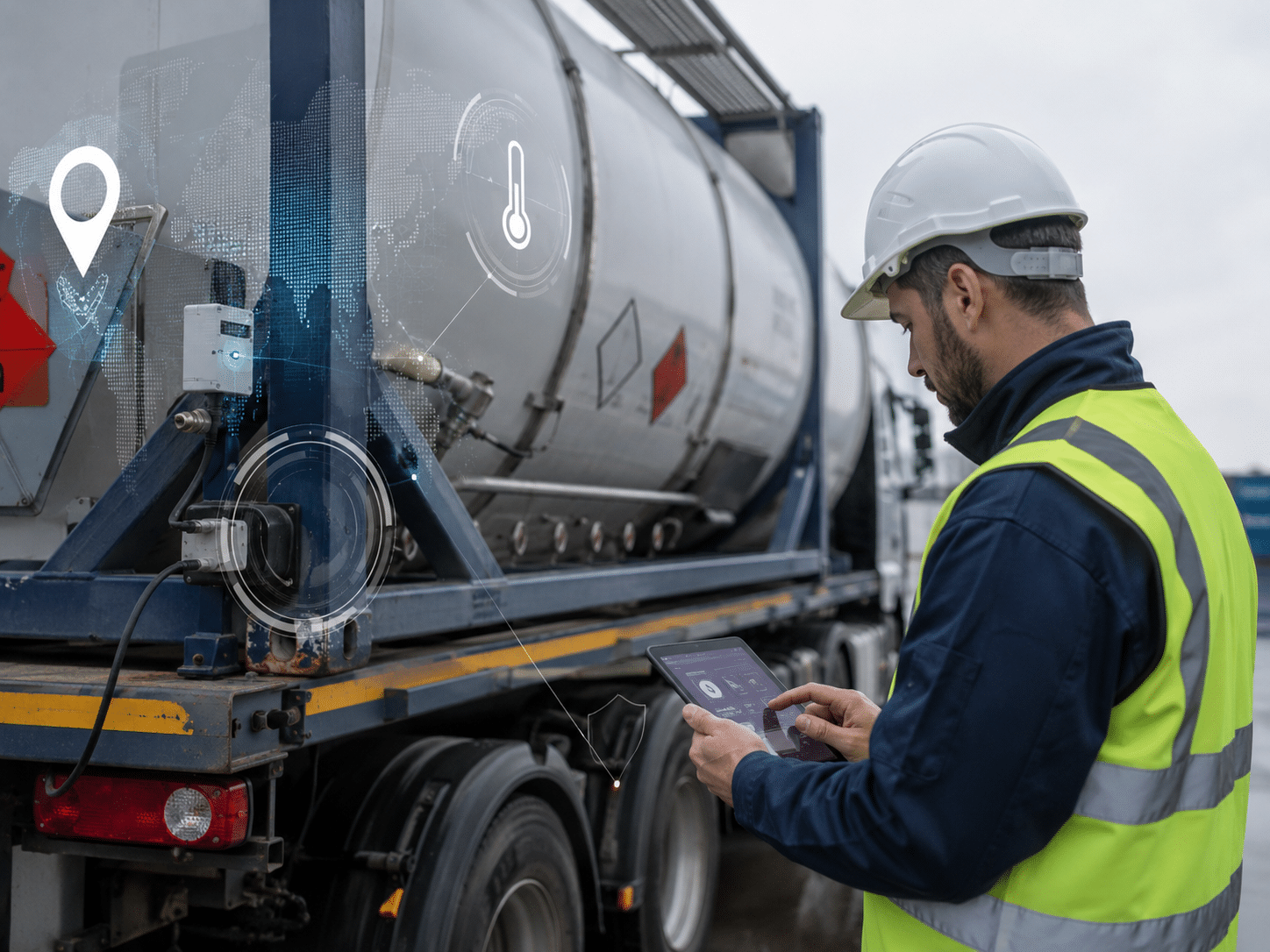
Real-Time TransparencyIn addition to software, the hardware used also plays a crucial role. Modern telematics systems enable seamless monitoring of vehicles and transport conditions.
The collected data is transmitted to central systems in real time and evaluated there. If deviations occur – for example, a temperature increase in a tank container – an alert is triggered immediately.
The Internet of Things (IoT) expands these possibilities even further. Intelligent sensors communicate with one another and enable even more precise monitoring of critical parameters. This creates a digital representation of the entire transport process.
Typical Hardware Components
Telematics and Dangerous Goods:- GPS trackers for determining position
- Sensors for measuring temperature, pressure, or humidity
- Acceleration sensors for detecting shocks or accidents
- Door sensors for monitoring loading openings
More Safety Through Mobile Devices and Apps
Dangerous Goods Transport- Digital checklists for vehicle and load inspections
- Access to safety data sheets
- Navigation with dangerous goods-specific route guidance
- Documentation of incidents via photo and report
Driver Assistance and Mobile Applications
Technology has also evolved significantly on the driver side. Mobile devices and apps support drivers in carrying out dangerous goods transports safely.
Typical functions include digital checklists for vehicle and load inspections, incident documentation via photo, or navigation assistants with dangerous goods-specific route guidance. Mobile devices and apps also provide quick access to safety data sheets.
These solutions are complemented by modern driver assistance systems in the vehicle itself. These include lane departure warning systems, emergency braking assistants, and turning assistants to help prevent accidents in urban traffic.
These systems actively help reduce accident risks – a decisive factor in dangerous goods transport.
Automated Documentation and Compliance
Documentation is a particularly critical area in dangerous goods transport. Incorrect or incomplete documents can not only lead to delays, but also cause significant safety risks.
Modern software solutions largely automate this process. They generate transport documents in accordance with ADR, dangerous goods declarations, emergency information for first responders, as well as inspection and audit logs.
Thanks to digital archiving, all documents are available at any time and stored in an audit-proof manner. At the same time, integrated compliance modules enable continuous checking of legal requirements.
More Safety Through Automated Documentation:
- Transport documents in accordance with ADR
- Dangerous goods declarations
- Emergency information for first responders
- Inspection and audit logs

Intelligent Route Planning Through Algorithms
Choosing the right route is of central importance in dangerous goods transport. Modern software uses complex algorithms that go far beyond conventional navigation.
Factors taken into account include legal restrictions, population density along the route, current traffic conditions, weather conditions, and risk zones.
By combining these factors, a risk-minimized route is created. In combination with real-time data, this route can even be dynamically adjusted – for example, in the event of traffic jams or accidents.
Factors Influencing Route Planning for Dangerous Goods Transport:
- Legal restrictions, such as tunnel bans
- Population density along the route
- Current traffic situation
- Weather conditions
- Risk zones, such as water protection areas
Interfaces and Integration:
The Key to Efficiency
The greatest strength of modern software and hardware lies in their connectivity. Dangerous goods transports are part of complex supply chains in which numerous systems need to communicate with one another.
A connected IT landscape may include, for example, an ERP system for order management, a WMS for warehouse processes, a TMS for transport planning, one or more telematics platforms for real-time data, as well as authorities and customs systems.
Open interfaces, or APIs, enable smooth data exchange. This creates end-to-end processes without media disruptions – a decisive factor for safety and efficiency.
Connected IT Systems for Monitoring Dangerous Goods Supply Chains:
- ERP systems for order management
- WMS for warehouse processes
- TMS for transport planning
- Telematics platforms for real-time data
- Authorities and customs systems


Predictive Safety: From Reaction to Prevention
By continuously analyzing data with the help of artificial intelligence, risks can not only be detected, but also predicted.
Examples include analyzing driving behavior to identify risky patterns, evaluating sensor data to detect technical problems at an early stage, or forecasting disruptions along the transport chain.
This “predictive safety” enables companies to act proactively and avoid potential hazards before they arise.
Methods for Predicting Risks:
- Analysis of driving behavior to identify risky patterns
- Evaluation of sensor data for early detection of technical problems
- Forecasting disruptions along the transport chain
Der Mensch im digitalen System
Trotz aller Technologie bleibt der Mensch ein zentraler Faktor. Der Unterschied liegt darin, dass Soft- und Hardware ihn gezielt unterstützen. Entscheidungen werden datenbasiert getroffen, Risiken transparent gemacht und Prozesse standardisiert.
Schulungen müssen daher zunehmend auch den Umgang mit digitalen Systemen umfassen. Nur wer die eingesetzten Technologien versteht, kann ihr Potenzial voll ausschöpfen.
Technologie als Garant für sichere Gefahrguttransporte
FazitGefahrguttransporte ohne Risiko sind in der Praxis nur durch das Zusammenspiel von Expertise und Technologie möglich. Moderne Soft- und Hardware schafft die notwendige Transparenz, reduziert Fehlerquellen und ermöglicht eine proaktive Steuerung der gesamten Transportkette.
Unternehmen, die in integrierte Systeme, intelligente Sensorik und datenbasierte Analysen investieren, heben ihre Sicherheitsstandards auf ein neues Niveau. Gleichzeitig steigern sie ihre Effizienz und erfüllen regulatorische Anforderungen mit deutlich geringerem Aufwand.
Die Zukunft des Gefahrguttransports ist digital, vernetzt und intelligent – und sie gehört denjenigen, die Technologie nicht als Zusatz, sondern als integralen Bestandteil ihrer Sicherheitsstrategie verstehen.
We will be happy to advise you on our products
We are here for you.Give us a call or send us a message. We look forward to welcoming you.
proLogistik Holding GmbH
Fallgatter 1
44369 Dortmund
Tel.: +49 (0) 231 5194-0
Tel.: +41 (0) 44 200 40-00
Tél.: +33 (0) 251 81 85 85